+212 770 02 63 23

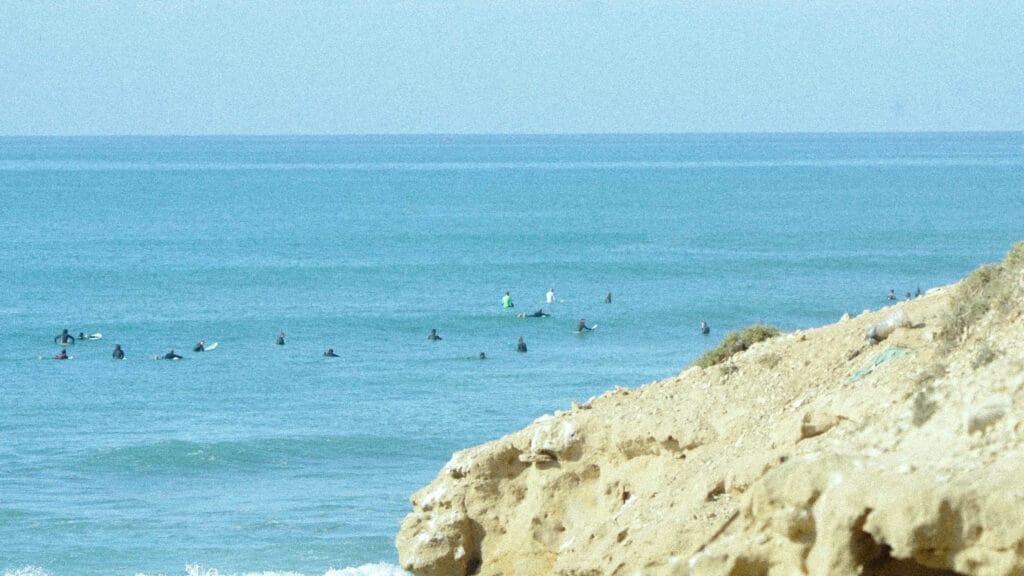
Table of Contents
When Is the Tamraght Surf Season?
The Tamraght surf season runs all year, but the character of the waves changes considerably from one season to another.
If you’re imagining the powerful Moroccan point-break surfing seen in surf films, October through March is the important window. North Atlantic swells become more frequent during this period, creating more opportunities for experienced surfers at the region’s point and reef breaks. Multiple current Tamraght guides identify roughly October/November through March as the prime period for stronger surf.
But that doesn’t mean Tamraght stops working when winter ends.
For someone learning to surf, smaller summer conditions can actually be an advantage. Beach breaks around the area can offer gentler waves, while experienced surfers may find fewer days suited to the kind of powerful surfing they came to Morocco for.
That distinction is important:
Winter brings Tamraght’s strongest surf potential, while the warmer months can provide more approachable conditions for learning.
So there isn’t one universal “surf season.” The useful question is which part of the Tamraght surf season suits your level?
Tamraght Surf Season at a Glance
| Period | General character | Usually most interesting for |
|---|---|---|
| September–November | Swell activity increases; warm conditions | Beginners to experienced surfers depending on the day |
| December–February | Strongest winter swell window | Intermediate and advanced surfers; beginners at appropriately selected spots |
| March–May | Transition toward smaller surf | Beginners and intermediates |
| June–August | Generally smaller surf; more wind can develop | Beginners, families and first-time surfers |
This should be treated as a seasonal guide, not a daily forecast. Swell direction, period, wind, tide and the individual break can completely change what a particular day looks like.
That’s why checking conditions shortly before surfing remains essential.
Tamraght Surf Season Month by Month
September: The Ocean Starts to Wake Up
September is an interesting transition month in Tamraght.
Summer isn’t completely gone. Days remain warm, and the ocean retains much of its summer warmth, but stronger Atlantic swell can begin appearing as the month progresses.
For surfers, that means variety.
A smaller day may suit someone working on the basics, while an incoming swell can suddenly give more experienced surfers better opportunities.
Current local surf guides similarly describe September as the beginning of improving autumn swell while conditions remain warm.
September suits: beginners, intermediates and surfers who like a mix of conditions.
October: The Surf Season Becomes More Active
By October, the transition toward Morocco’s main Atlantic swell season becomes much clearer.
More regular swell can start activating a wider variety of breaks around Tamraght and the Taghazout coastline.
This is also where local knowledge becomes particularly valuable. One beach may be too exposed while another break nearby offers much more manageable waves.
For travelling surfers, October can therefore offer something particularly useful: more swell options without being deep into the winter season.
November: Winter Surf Starts Taking Shape
November is when the classic Moroccan surf-season feeling becomes more established.
North Atlantic swell becomes increasingly relevant, giving intermediate and advanced surfers more opportunities to explore the area’s better-known waves.
Surf Atlas specifically identifies November through March as the core Tamraght season.
Beginners shouldn’t interpret bigger swell as meaning they cannot surf. The important difference is spot selection.
When exposed breaks are too powerful, an experienced local surf instructor can look for a more sheltered location appropriate for learning.
December: Winter Swell Arrives
December sits firmly inside Tamraght’s winter surf period.
This is when surfers travelling to Morocco for stronger waves are much more likely to see the type of conditions for which the Taghazout–Tamraght coastline became internationally known.
The nearby coastline offers a mixture of beach breaks, reefs and points, so surfers shouldn’t judge conditions simply by looking at one beach.
For beginners, winter requires more careful decision-making.
Bigger surf doesn’t automatically mean better surf for learning.
A smaller, cleaner wave appropriate to your ability will normally be far more productive than paddling into conditions beyond your experience.
January: Peak Winter Conditions
January sits in the heart of the Tamraght winter surf season.
It is one of the months when powerful North Atlantic swell is most relevant to the region. Current local guides generally place December–February within the strongest part of the year.
Experienced surfers have more potential options when conditions align.
Beginners, however, need suitable beaches and sensible wave selection rather than simply following experienced surfers into famous spots.
This is one reason professional instruction is particularly useful during the winter months: the right surf spot can matter as much as the lesson itself.
February: Still Prime Winter Surf
February continues the winter pattern.
There can still be substantial swell, and intermediate or advanced surfers visiting specifically for Morocco’s stronger waves remain within the main seasonal window.
Water is cooler than in summer, so a full wetsuit is normally appropriate.
Published local guides generally put winter sea temperatures around 16–18°C or 17–19°C, although actual temperature varies.
For your trip, check current sea temperature rather than treating seasonal averages as a guarantee.
March: A Transition Begins
March is an interesting month because Tamraght begins moving away from the heart of winter.
There can still be quality swell, but conditions gradually transition toward spring.
For improving surfers, that can be particularly attractive. You aren’t necessarily looking for the biggest wave available; you’re looking for waves that let you catch more unbroken waves, practise positioning, and develop consistency.
This makes spring worth considering rather than automatically assuming winter is “better.”
Spring Surfing in Tamraght
April
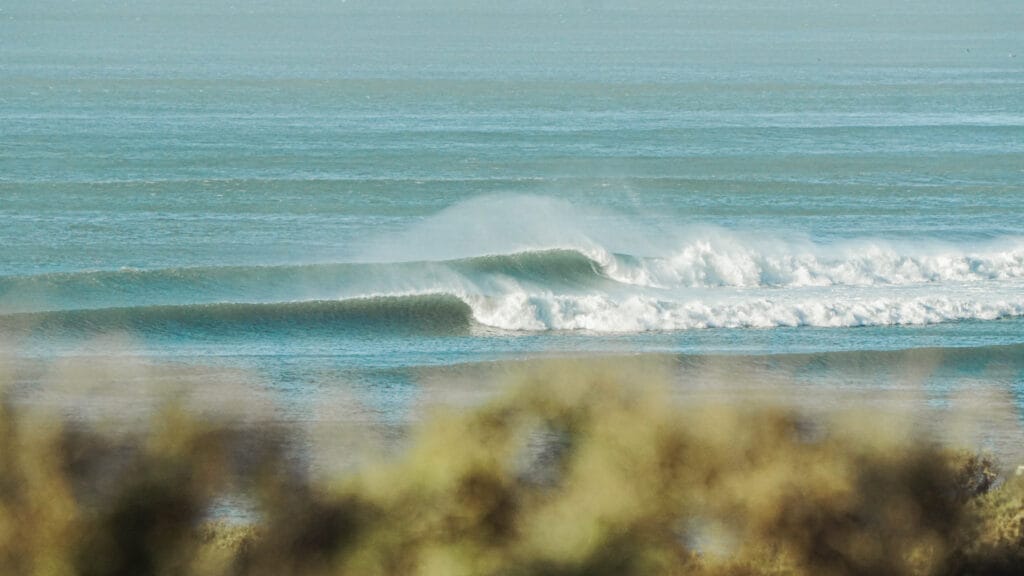
April moves further into the shoulder season.
The huge winter reputation of Morocco sometimes causes travelling surfers to overlook spring, but smaller conditions can be beneficial for beginners and developing intermediates.
You may also have warm weather on land while still needing a wetsuit in the Atlantic.
May
By May, the coastline is moving closer to its summer pattern.
The likelihood of the large, regular winter swells decreases, but that’s not necessarily bad news.
If your objective is to:
- take your first surf lesson;
- improve your pop-up;
- practise paddling;
- catch more manageable waves;
- build confidence in the ocean;
Smaller conditions can be exactly what you need.
This is where surf quality becomes relative to skill level.
A head-high wave might excite an experienced surfer and intimidate a first-timer. A small beach-break wave can look uninteresting to an advanced surfer while providing an excellent learning environment.
Summer Surfing in Tamraght
June
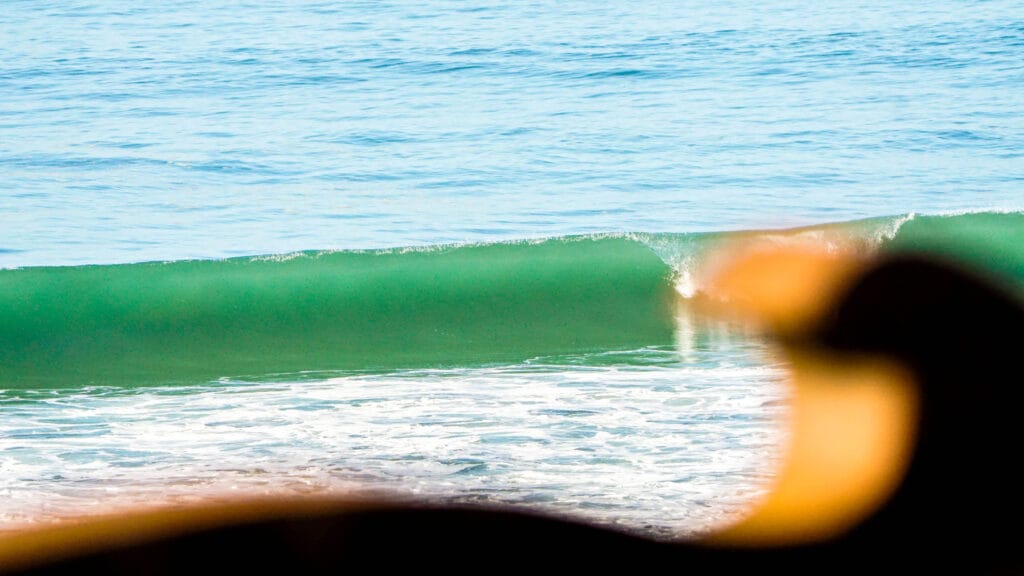
June marks the beginning of the quieter swell period.
North Atlantic winter activity has faded considerably, and conditions generally become smaller.
This makes summer less attractive to surfers whose only objective is chasing powerful Moroccan point breaks.
For beginners, the story can be completely different.
July
July typically sits among the smaller periods of the year.
Current Tamraght-area sources describe summer as having gentler surf and note that afternoon wind can become an important factor.
That makes timing your session particularly important.
When wind is forecast to strengthen later in the day, an earlier session may offer a cleaner surface.
But conditions change daily, so don’t rely on the calendar alone.
August
August continues the summer pattern: warm weather and generally smaller surf compared with winter.
For complete beginners and families, this can be a very appealing combination.
For advanced surfers planning a Morocco trip specifically for large point-break waves, however, winter offers much greater potential.
And then September arrives—and the seasonal cycle starts turning again.
Is Winter or Summer Better for Surfing in Tamraght?
Neither is universally better.
They serve different surfers.
Choose the autumn/winter period if:
- you already surf confidently;
- you’re looking for stronger Atlantic swell;
- you want more opportunities to surf Morocco’s point breaks;
- you are comfortable adapting to more powerful conditions.
Consider spring/summer if:
- you’re learning to surf;
- smaller waves are an advantage rather than a disadvantage;
- you’re travelling with children or other beginners;
- warm weather matters to you;
- your priority is progression rather than chasing large surf.
For many beginners, the biggest misconception is assuming peak surf season automatically means the best time to learn.
It doesn’t.
The best learning conditions are waves that match your ability.
What Happens to Tamraght’s Waves in Winter?
The answer starts thousands of kilometres away.
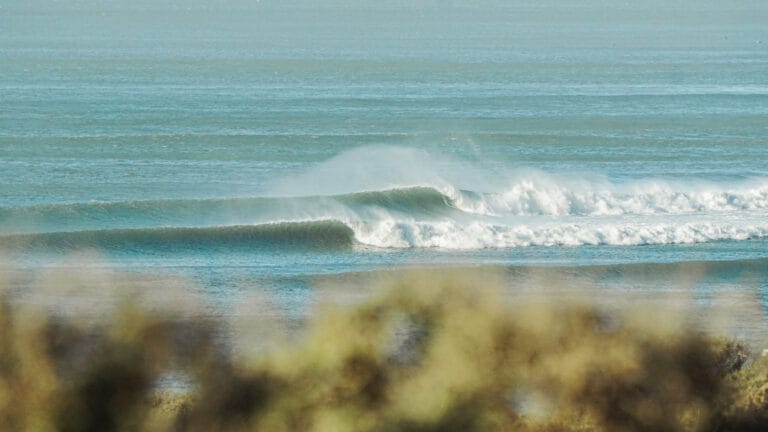
During the Northern Hemisphere winter, storms over the North Atlantic generate energy that travels across the ocean as swell.
When this energy reaches Morocco’s Atlantic coastline, the local seabed and coastline determine how those swells turn into surfable waves.
That’s why two nearby surf spots can look very different on the same morning.
One may receive the swell directly while another is partially protected.
And this is also why swell height alone doesn’t tell you whether Tamraght will be good for surfing.
You need to consider:
swell height + swell period + swell direction + wind + tide + surf spot + surfer ability.
We’ll go much deeper into those factors in our upcoming Tamraght Surf Forecast Guide.
That internal separation is deliberate: this article explains seasonality, while the forecast guide will explain how to read a particular day’s conditions.
Which Tamraght Surf Spots Work During the Season?
Tamraght is particularly useful as a surf base because you aren’t restricted to one wave.
The surrounding coastline provides access to different types of breaks.
Local options commonly associated with the area include Devil’s Rock, Crocro/Imourane, and Banana Point, while famous waves such as Anchor Point are farther north near Taghazout.
The right choice depends on the day’s conditions and your ability.
Our current site also positions Tamraght as a base for surf experiences and lessons rather than relying on one fixed beach.
We’ll cover individual breaks separately in our surf-spot series rather than turning this seasonal guide into another “best surf spots” article.
That includes upcoming dedicated guides to:
Devil’s Rock → Crocro → Banana Point → Anchor Point.
What Wetsuit Do You Need During the Tamraght Surf Season?
Although Morocco is famous for sunshine, Atlantic water isn’t tropical.
Winter guides for the Tamraght area commonly report sea temperatures in roughly the upper teens Celsius, while summer water is generally warmer.
As a practical starting point:
| Season | Practical starting point |
|---|---|
| Winter | Full wetsuit, commonly around 3/2 mm |
| Spring | Usually a full suit remains useful |
| Summer | Lighter neoprene may be comfortable depending on the person |
| Autumn | Depends on month and personal cold tolerance |
Don’t choose a wetsuit purely from a yearly table. Water temperature, wind, session length, and your tolerance to cold all matter.
We also have “What Wetsuit for Morocco Surfing” scheduled as its own detailed guide later in our content plan, so this section should remain concise.
Beginners: Don’t Chase the “Best” Month—Chase the Right Conditions
This is perhaps the most useful advice we can give someone planning their first surf trip to Tamraght.
Google can tell you which month historically receives more swell.
It cannot tell you whether tomorrow’s waves are appropriate for you without looking at the actual conditions.
A beginner needs manageable waves, suitable depth, an appropriate board, and a safe learning environment.
That’s where local experience becomes much more valuable than simply booking your trip around the biggest swell months.
At Tamraght Surf Experience, our focus is on matching the surfing experience to the person and the conditions—not forcing every surfer onto the same wave.
Explore Tamraght Surf Experience
Tamraght Surf Season FAQ
Can you surf in Tamraght all year?
Yes. Surfing is possible throughout the year around Tamraght, but wave size, consistency, wind and suitable surf spots change seasonally. Winter generally offers stronger Atlantic swell, while summer tends to produce smaller conditions that can suit beginners.
What is the main surf season in Tamraght?
For surfers seeking stronger, more consistent Atlantic swell, roughly October/November through March is generally considered the main season.
Is Tamraght good for beginners in winter?
It can be, as long as the spot and conditions are right. Winter can produce powerful surf at exposed locations, so beginners benefit from local spot selection and instruction.
Is Tamraght worth visiting for surfing in summer?
Yes, particularly for beginners, families, and surfers comfortable with smaller waves. Summer is not the prime season for Morocco’s famous large point-break surf, but smaller conditions can be useful for learning.
When do the biggest waves arrive in Tamraght?
The strongest swell potential is generally associated with the Northern Hemisphere winter, particularly around December–February. Individual storms and swell events determine actual conditions.
Does Tamraght have waves every day?
No surf destination can guarantee suitable waves every day. Tamraght benefits from access to multiple nearby breaks, but actual surf depends on swell, wind, tide and local conditions.
Should I choose my surf spot before arriving in Morocco?
Not necessarily. A better strategy is to know your ability and choose the spot according to the day’s conditions. Even established Tamraght surf schools describe selecting locations according to swell, wind, tide, and surfer level.
Final Takeaway
The Tamraght surf season isn’t simply winter versus summer.
Autumn brings increasing swell. Winter delivers the greatest potential for powerful Atlantic surf. Spring offers a useful transition, and summer generally brings smaller waves that can be excellent for beginners.
The important part is matching the season—and then the individual day’s surf spot—to your ability and goals.
If you’re coming to Tamraght to catch your first waves, improve your surfing, or experience the Moroccan coast with locals who know the area, explore Tamraght Surf Experience and choose a surf experience that fits your level.